Multi-robot assembly. Two arms, one part, and the physics between them (demo coming soon).
Two robot arms that learn to assemble a satellite panel module against real contact physics: splitting the work, and holding and fastening one bracket together.
Getting several robots to do useful work together still takes weeks of programming, and a small physical change breaks it. We are building a two-arm cell that learns its assembly skills against real contact physics instead. It is not finished; the demo is coming soon.
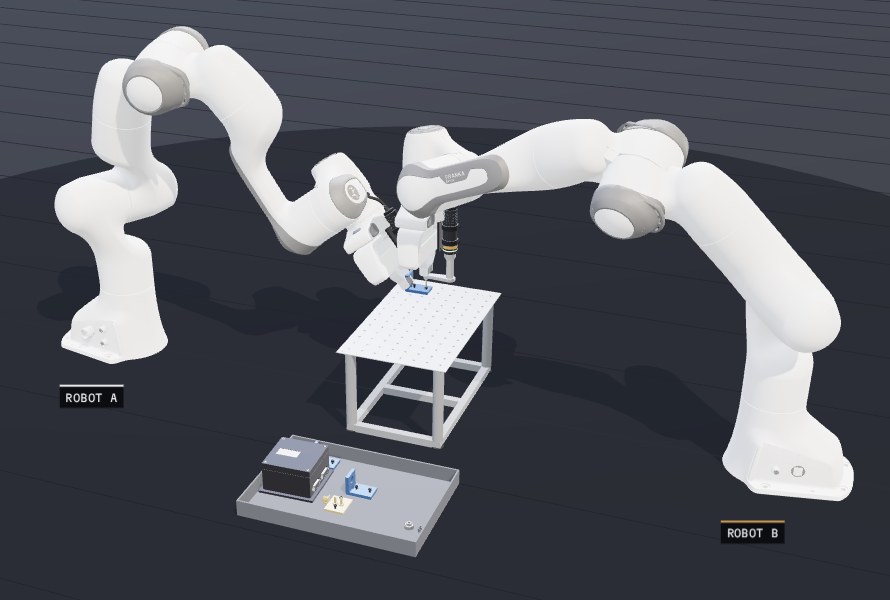
Hold and fasten: robot A holds a bracket by its leg while robot B drives its screws. A recorded run of the trained policies.
The problem
In our conversations with people on factory floors, one complaint kept coming up: getting several robots to do useful work together takes a long time to program. Small physical changes, such as a different friction, part weight or fit, then break the program, and someone has to tune it again.
Tasks that are mostly physics, like driving a screw or holding a part another robot is working on, are harder still:
| What makes it hard | Why |
|---|---|
| Contact is abrupt | Parts stick, slip, touch and separate, and a millimetre of error decides whether a screw engages or cross-threads |
| Success is about force, not just position | Torque, preload and grip force matter, and cameras cannot see them |
| The physics is hidden and varies | Friction, stiffness and fit change from part to part and are never measured on the line |
| Parts bend and break | Thin panels, boards and cables flex, and pushing too hard cracks them |
| Two robots on one part fight each other | Their forces pass through the part, so each must react to what the other is doing |
| Fast physics drifts from reality | Accurate contact is too slow to train on, fast contact drifts, and there is almost no real data of robots sharing a part under force |
What we are building
Two robot arms assemble part of a satellite side-panel module from a random kit of loose parts, with no part-specific fixtures. Sometimes the robots split the work to go faster. Sometimes both must act on the same part at once: one holds a bracket while the other screws it down (Fig. 2).
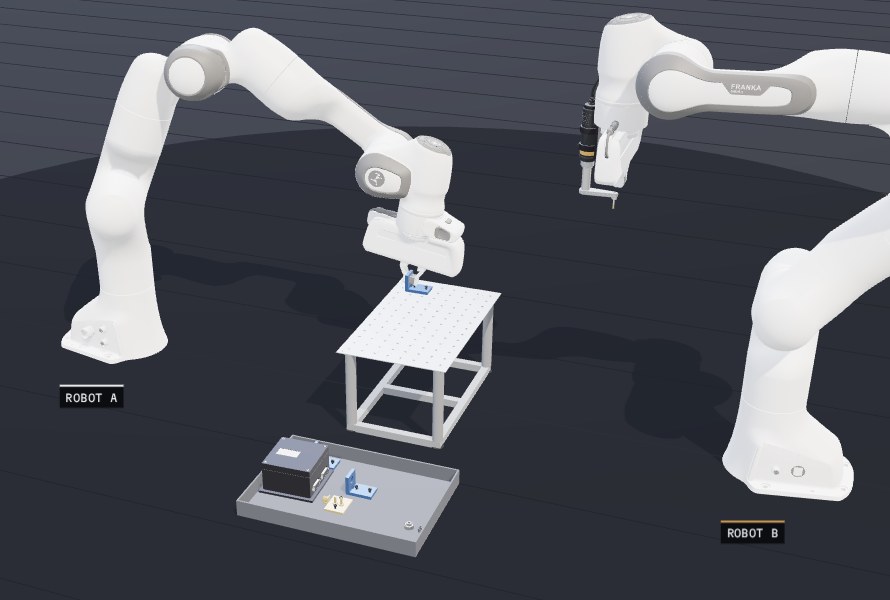
Split the work: A places the brackets, B fastens them.
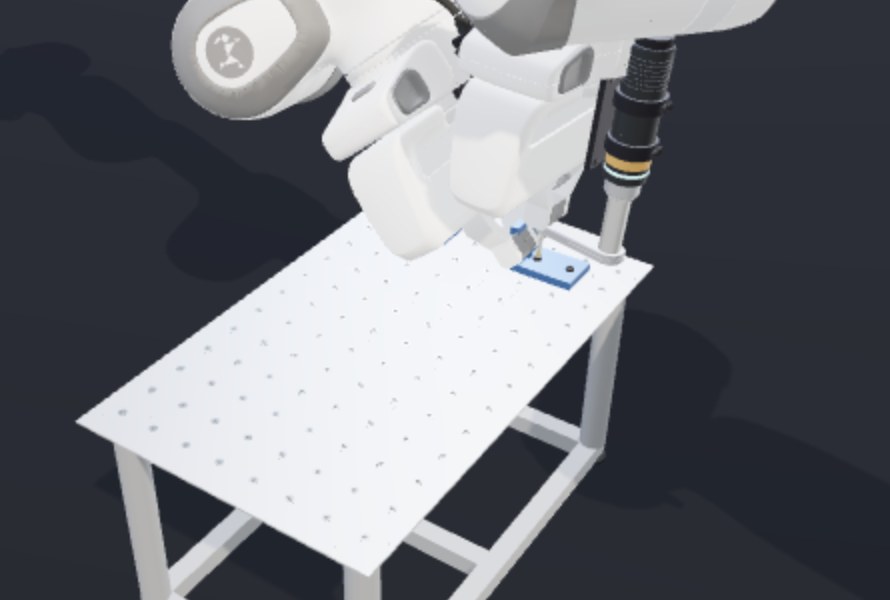
Together: A holds the bracket by its leg, B drives the screw.
- Contact physics, not animation. The cell runs in Newton with MuJoCo-Warp at 200 Hz. Screws are driven by a torque law (spindle torque, thread engagement, clamp torque at the seat), not faked.
- Learned skills, not scripts. Placing brackets and driving screws are reinforcement-learning policies running closed-loop at 25 Hz. Every screw in the demo is now driven by a learned policy. The hold-and-fasten step uses one shared team policy that both robots run.
- Built to scale. Each robot runs its own copy of the same policy, reading one shared scene graph of robots, parts and contacts. We start with two robots, but the design is meant to scale: the goal is that a new robot joins with little or no post-training, and that a new skill needs only a short post-training run, not a new program. We are not there yet; that is where the architecture is headed.
How the arms share a build. On the left each arm works on its own part; on the right both act on the same bracket at once, so their steps are linked.
Where it stands
We are still building this demo. It is not finished, and we keep adding capabilities. The demo is coming soon, with the same recorded runs in a browser that Fig. 1 and Fig. 2 come from.
What it opens up
Much of the assembly still done by hand stays manual because it is physics-heavy, high-mix, or needs a second pair of hands: satellite and aircraft panels, electronics, cable harnesses, soft goods. Robots that learn a new task in a computed cell instead of being programmed, that adapt to each part's physics in real time, and that work together on the same part can automate these areas for the first time. A changeover that takes weeks of programming becomes a retraining run, so short runs and custom products become worth automating. The satellite module is our first proof. Next come flexible boards, carrying large panels together and routing cables.
One core under it
The robots rest on the same physics as Preprint, our metal 3D printing demo. Contact, friction and the seating of a screw obey the same conservation laws as heat in a melt pool, so the core is built once and each domain adds only its own materials, events, sensors and controls. Contact and friction learned from the robots help model powder and tooling; heat and phase change learned from printing help casting and reflow. Each customer's process stays private, while the physics underneath compounds for everyone.