Physics world model for physical AI
Pre-seed · Oct 2026

The physics playground for physical AI.

A world model grounded in physics, making advanced engineering intelligence computational, accessible and scalable.

Mission
Democratize the physical world
01 · The moment
Language AI had it first

One model learned the world of text. Physical AI is still waiting for its moment.

Robots, autonomous machines and self-optimizing factories are arriving fast. What they lack is knowledge of the physical world.

Solids
How materials deform
Stress, strain and failure under load.
Thermal
How heat flows
Conduction, cure and phase change.
Contact
How parts collide
Impact, friction and slip.
Action
How a process answers
The consequence of a change to a recipe, a path or a design.
02 · Why physics
The most faithful way to learn the world
Thesis
Conservation of mass, momentum and energy holds everywhere. A model grounded in them can reason beyond the data it has seen.
Today · a false choice

Trusted, or fast

Classical solvers are trusted and take hours. Learned surrogates are fast and break outside their training data.

Apsidion · both

Trusted and fast

Fast enough to act in real time, faithful enough to trust, general enough to explore what has never been built.

03 · Five gaps
All five, in one model

Five gaps stand between computation and a world model physical AI can use.

Each tool on the market fixes one or two and drops the rest. Miss one, and the real process can be neither predicted nor steered.

Too slow at scale
Gap 01
Serial, stability-limited time steps; attention that explodes across a million elements. It blocks real-time control.
Siloed representation
Gap 02
Grids and particles cannot hold discontinuities and smooth fields at once. It blocks coupled phenomena. No tool solves it
No gradient at a discontinuity
Gap 03
Tearing, phase change and step change break differentiation. It blocks inverse design and closed-loop tuning. No tool solves it
Blind to reality
Gap 04
Parameters fixed offline, no live sensor stream. It blocks adapting to drift, wear and ageing.
Lost outside its data
Gap 05
Learned operators map functions, not physics. It blocks exploring designs nobody has made yet.
04 · The world model
Seven layers, one core

The physics is shared, so the world model is built once.

A new vertical brings only its materials, events, sensors and actions. The core stays the same, and every deployment makes it better.

Seven layers
Each built on the one before
Physical state
Foundation
Differentiable kernel
Gradients
Large physics model
Prior
Learned closures
Uncertainty
Hidden state
Estimation
Action-conditioned
Consequence
Inverse reasoning
Verification
Shared core · identical in every vertical
typed-edge tokensflux headlocal attentioncoarse gridevent headswitch layer
Where it goes
Manufacturing first
00
Manufacturing
01
Industrial robotics
02
General robotics
03
Machine design
04
The human body
05 · Proof
Measured, not modelled

Every deployment makes the next one cheaper.

Deploy on a live process, calibrate the residuals, grow the shared library, retrain the core. The next process starts with fewer trials.

Automotive assembly · deployed
100k+cycles
Defect-free, from one of the most defect-prone manual stations on the line.
Footwear robotics · per variant
~90%
Less work-cell setup and robot reprogramming for each new design.
Proposals in progress
4
Aerospace, foundry, electronics and process machines.
Programme 01 · Tether
Demo · in development

Tether

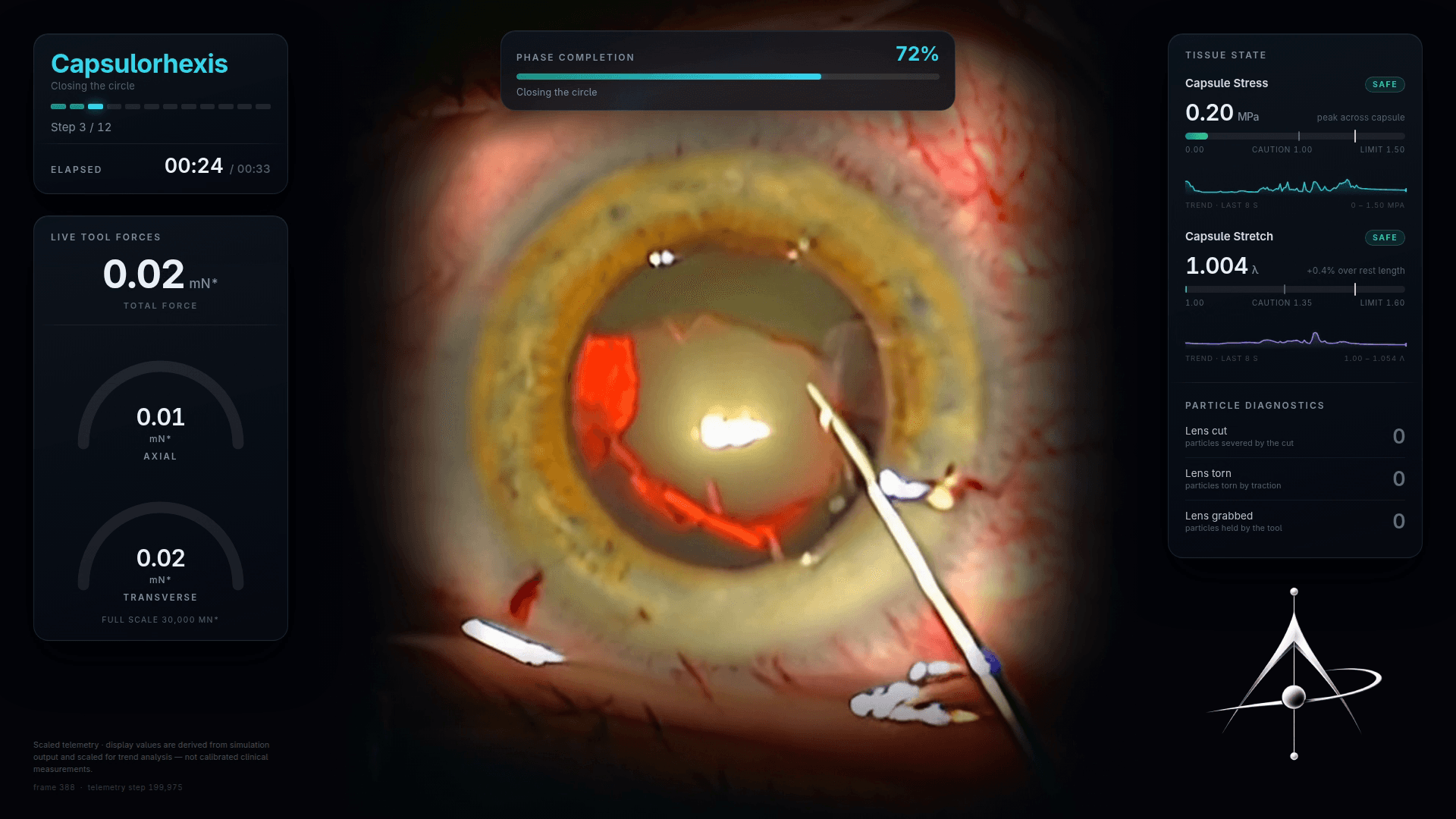
A multi-material virtual capsulorhexis: coupled tissue physics that responds to discrete surgical actions.

Programme 02 · Praxis
Manufacturing · in development

Praxis

Recipes, toolpaths and process windows found by inverse physics and validated before the line is set up.

The next frontier
Whoever learns the physics of the real world first, from real processes, holds a model no one can copy from public data.
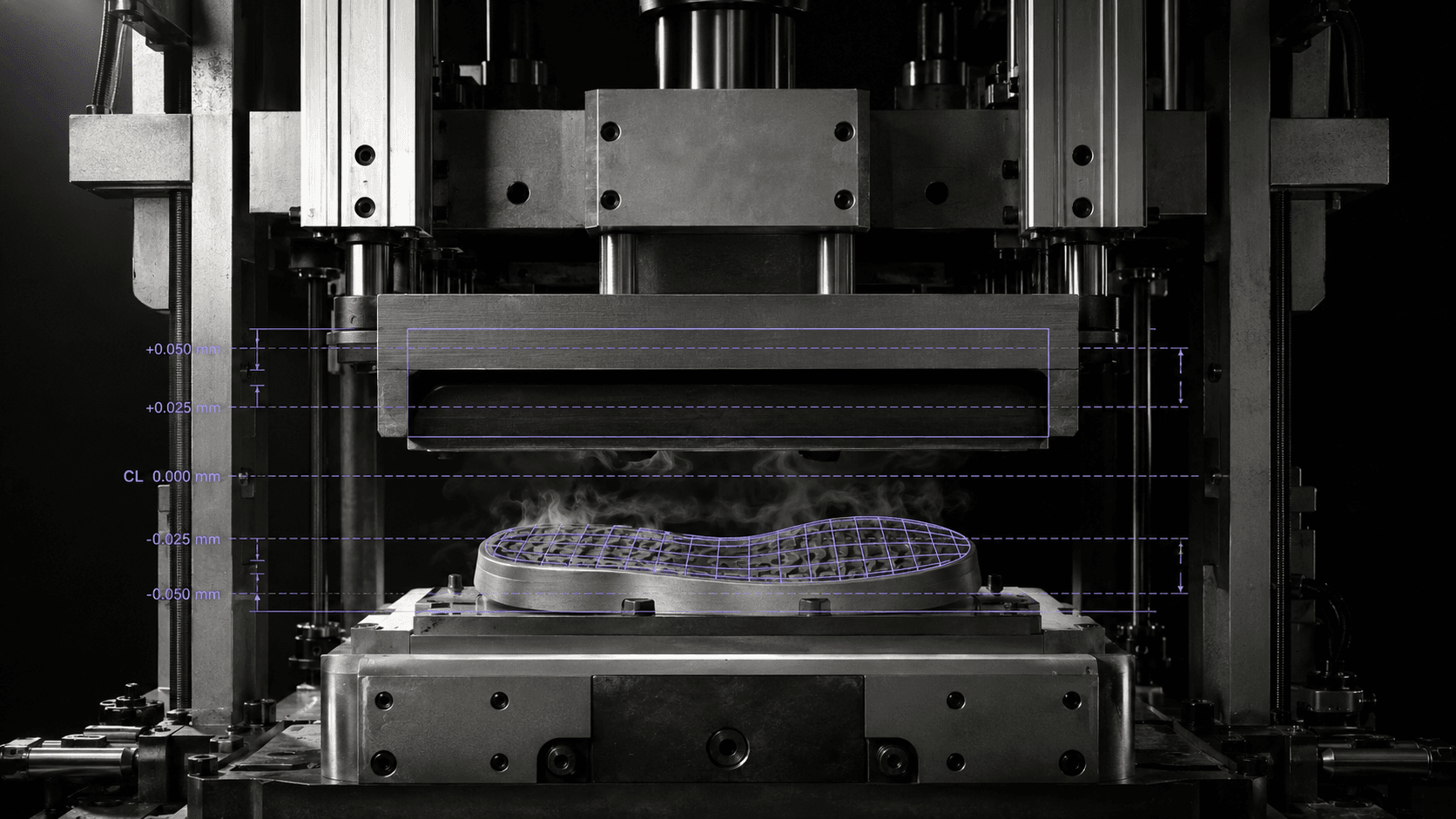
Every deployment compounds it · physics shared, recipes private